Henri Matisse · 1910
The Dance
Posters from $10.82 USD · Canvas from $28.14 USD
Ships anywhere in the USA
Matisse's revolutionary frieze — five naked figures linked in a circular dance against pure cobalt sky and emerald ground. The painting that announced 20th-century art. Hermitage, St. Petersburg.
Up to 12.2 × 8 in · landscape
Size
Larger sizes are unavailable for this painting because the source scan's resolution wouldn't print at gallery quality.
Format & finish
Archival cotton canvas stretched over a wooden frame. Ready to hang as-is. No external frame.
Scale next to a 5'10" person
No sales tax added at checkout
Visa · Mastercard · Amex · Discover · Apple Pay · Google Pay
Materials & quality
›Canvas & inks
Giclée-printed on archival cotton canvas with fade-resistant pigment inks, hand-stretched over wooden bars. Gallery-wrapped — ready to hang with no extra frame needed.
›Floater frame
Hand-finished solid wood floater frame in five finishes. The canvas sits inside with a clean shadow gap — the way galleries hang contemporary canvas.
›Posters
Premium archival paper — 200 gsm soft matte or 230 gsm vibrant glossy. Ships flat or rolled, ready for your own frame.
›Faithful to the source
Printed from the highest-resolution museum and archive scans available. Each painting's maximum size is capped at what its source scan can support at gallery quality.
The story of The Dance
Five figures the color of terracotta hold hands in a ring on a green hill under a blue sky, and that is the entire painting. Matisse made it in 1910 for the staircase of a Moscow collector's house, and it is now in the Hermitage in St. Petersburg. There is no shading, no landscape detail, no faces to speak of. The energy comes from the ring itself, which is not quite closed: the two figures at the front are reaching for each other and have not yet caught hold. It was mocked when it was shown and is now one of the founding images of modern art.
On a wall, The Dance is pure color. The three flat tones, brick red, emerald green, and cobalt blue, are as saturated as a flag, so the painting is a bright spot in any room and looks best against white or pale gray where the colors can vibrate. It suits a kitchen, a kids' room, a studio, a stairwell, or a hallway, and it fits mid-century, Scandinavian, and color-confident modern interiors. Our source image supports the Mini at 12.2 × 8 in, so this one is a small-wall piece: hang it above a desk, over a light switch cluster in a hallway, or as the color note in a gallery wall of black-and-white prints.
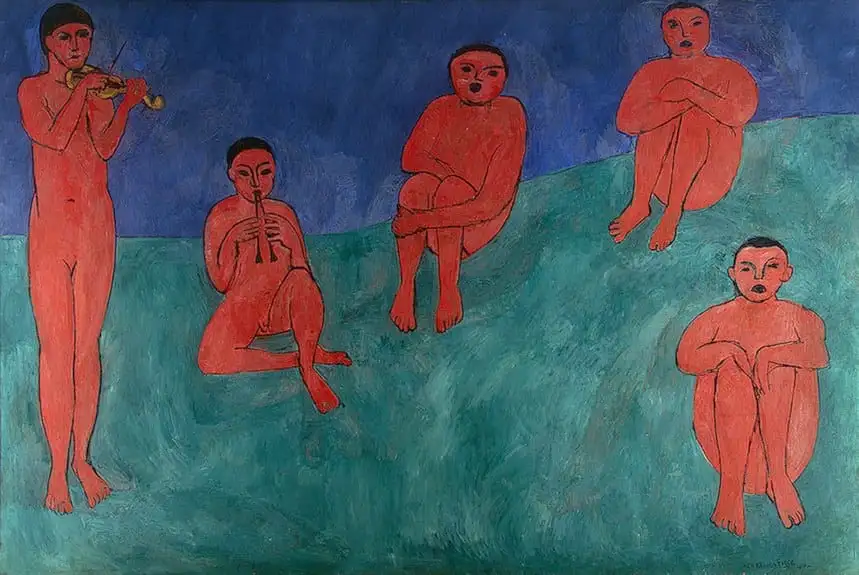
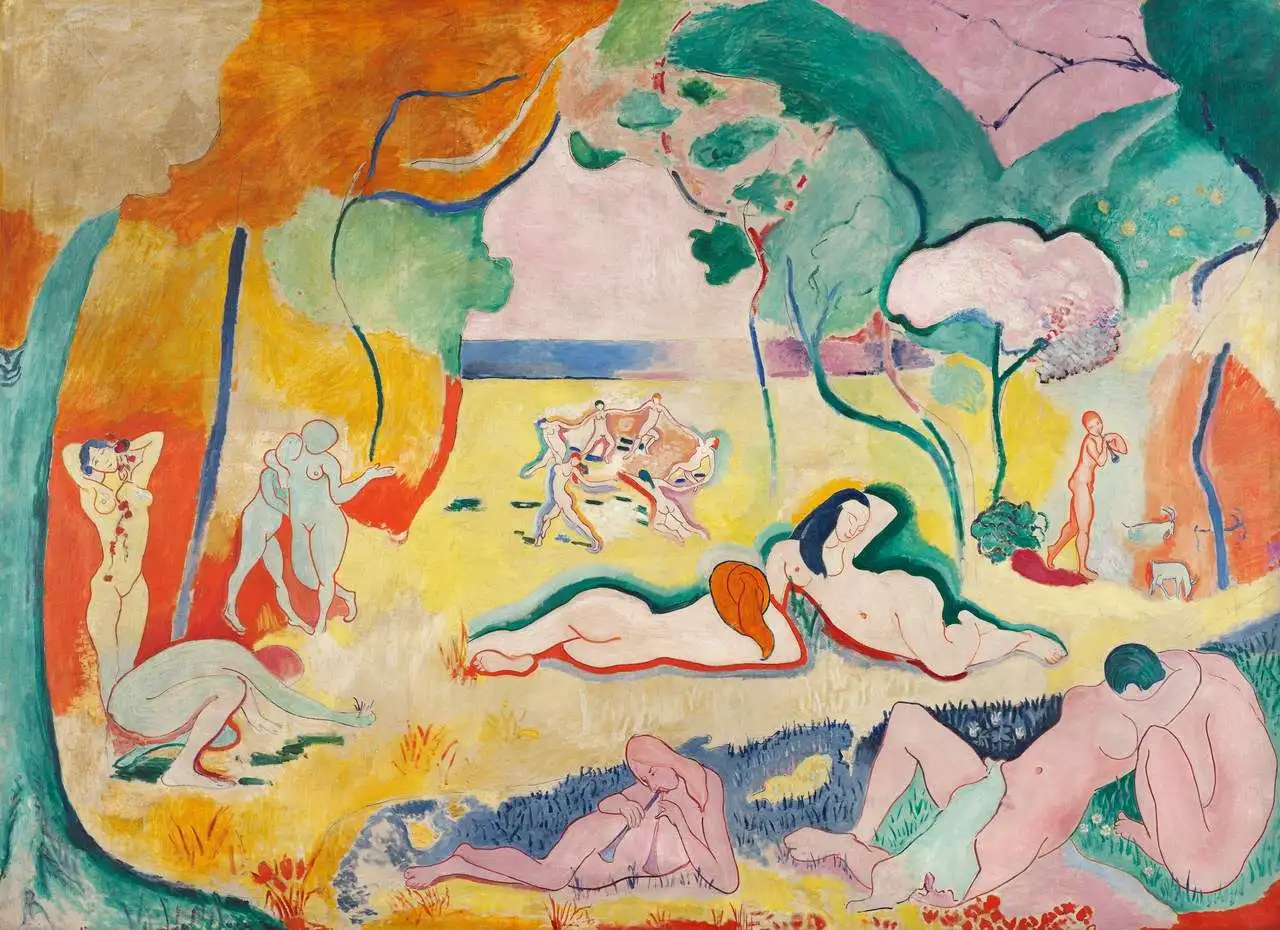
Its companion, Music, was painted for the same staircase and uses the same three colors with the figures sitting still. Le Bonheur de Vivre has the same ring of dancers in the far distance five years earlier, and Derain's Mountains at Collioure is the Fauvist landscape from the summer that started it all. More from Henri Matisse.
We print from a public-domain photograph of the Hermitage canvas in our own studio, matching the three colors to the museum reference rather than to the brighter versions that circulate online.
Henri Matisse
Henri Émile Benoît Matisse was a French visual artist, known for both his use of colour and his fluid and original draughtsmanship. He was a draughtsman, printmaker, and sculptor, but is known primarily as a painter.
All Henri Matisse prints →Biography adapted from Wikipedia, available under CC BY-SA 4.0.
You may also like
Henri Matisse · 1910
Music
Mini
From $10.82 USD
Henri Matisse · 1905–06
Le Bonheur de Vivre (The Joy of Life)
Mini · Petite · Small · Medium
From $10.82 USD
Henri Matisse · 1912
Goldfish
Mini
From $10.82 USD
Henri Matisse · 1905
Woman with a Hat
Mini
From $10.82 USD
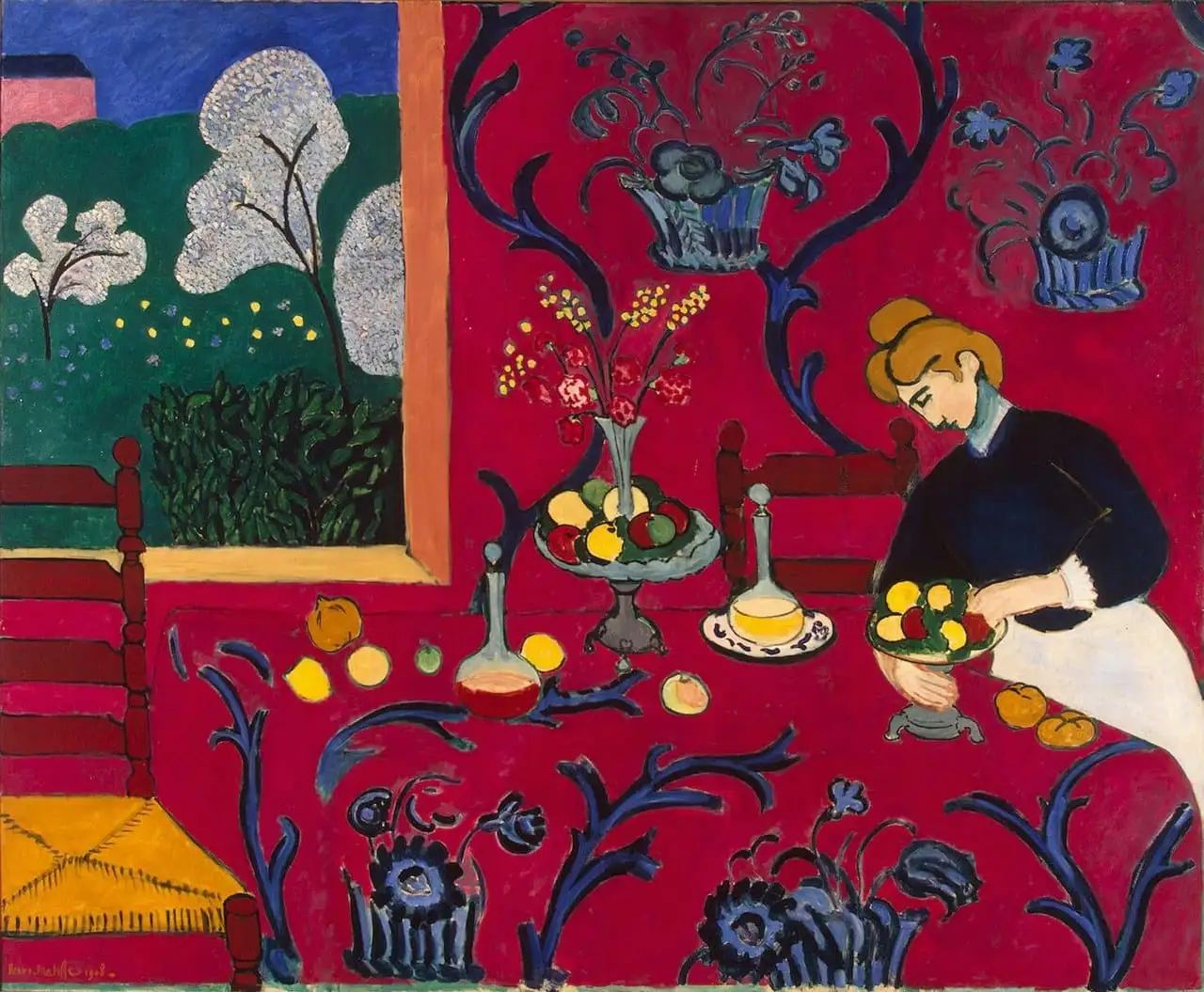
Henri Matisse · 1908
Harmony in Red (The Red Room)
Mini
From $10.82 USD
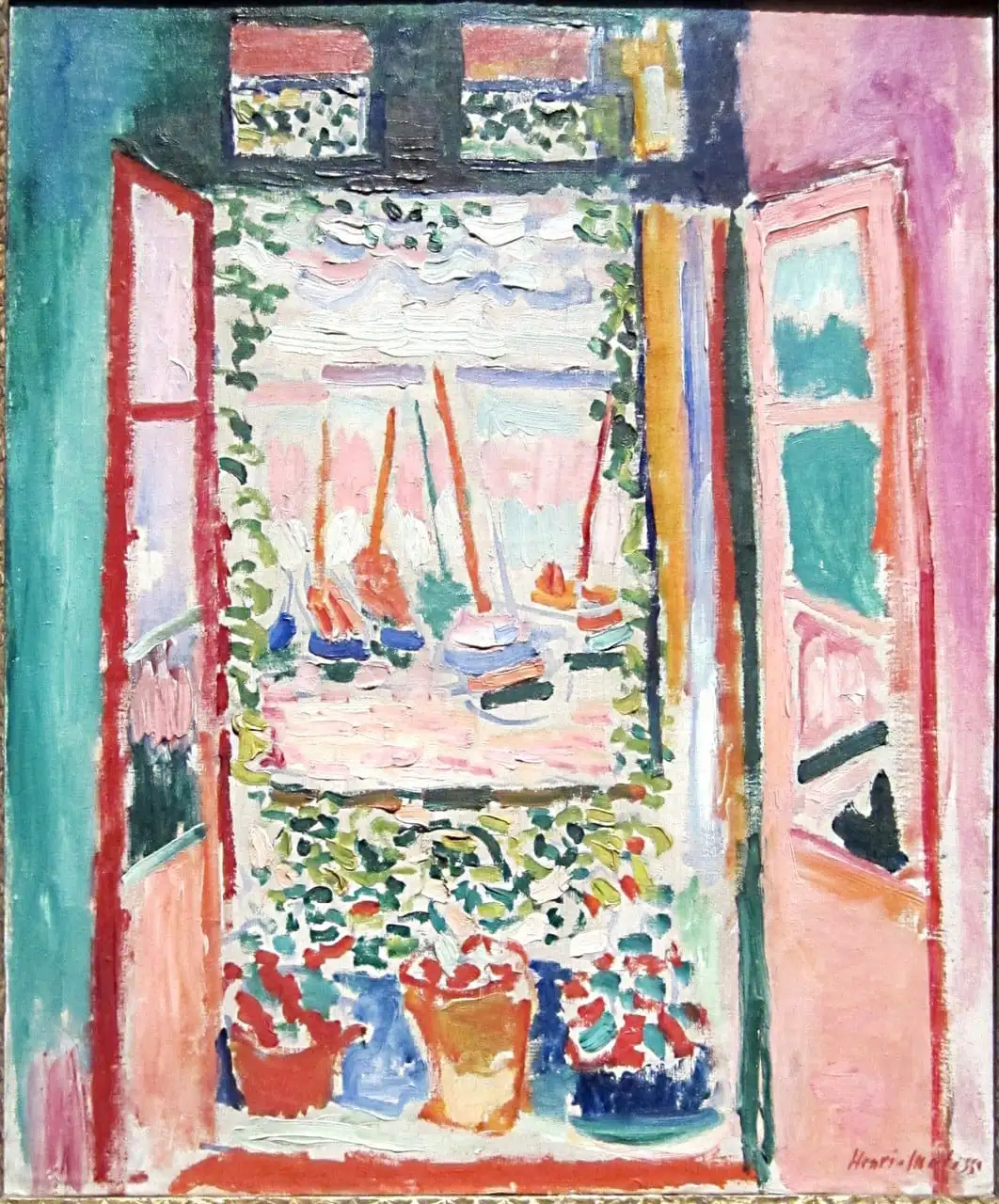
Henri Matisse · 1905
The Open Window, Collioure
Mini
From $10.82 USD